A new bell-ringing method for RING OUT
Added:
‘Frome Festival Treble Place Major’1
Composed by Julian Back. Described by Julian Back
Change Ringing
Traditional English church bells are usually quite heavy (typically between 1cwt and 20cwt although the heaviest is over 80cwt). We ring them by swinging them through almost a full circle. Each bell has considerable momentum when swinging and the ringer can only alter the speed of swinging (and thus the timing of the clapper striking the bell) by a relatively small amount on each pull of the rope. This means it is not normally possible to play normal tunes on church bells. The art of change ringing was developed in the 17th century. In change ringing we start off ringing a sequence called “rounds”. Rounds starts with the lightest bell (the treble) which has the highest note and continues in order of weight to the tenor (the heaviest bell with the lowest note). The bells are numbered in weight order starting with the treble so on a ring of eight bells rounds would be the sequence 12345678. In change ringing we swap one or more adjacent pairs of bells each time to produce different “changes”, for example: 12345678 -> 21436587 -> 24163857 etc.
Methods
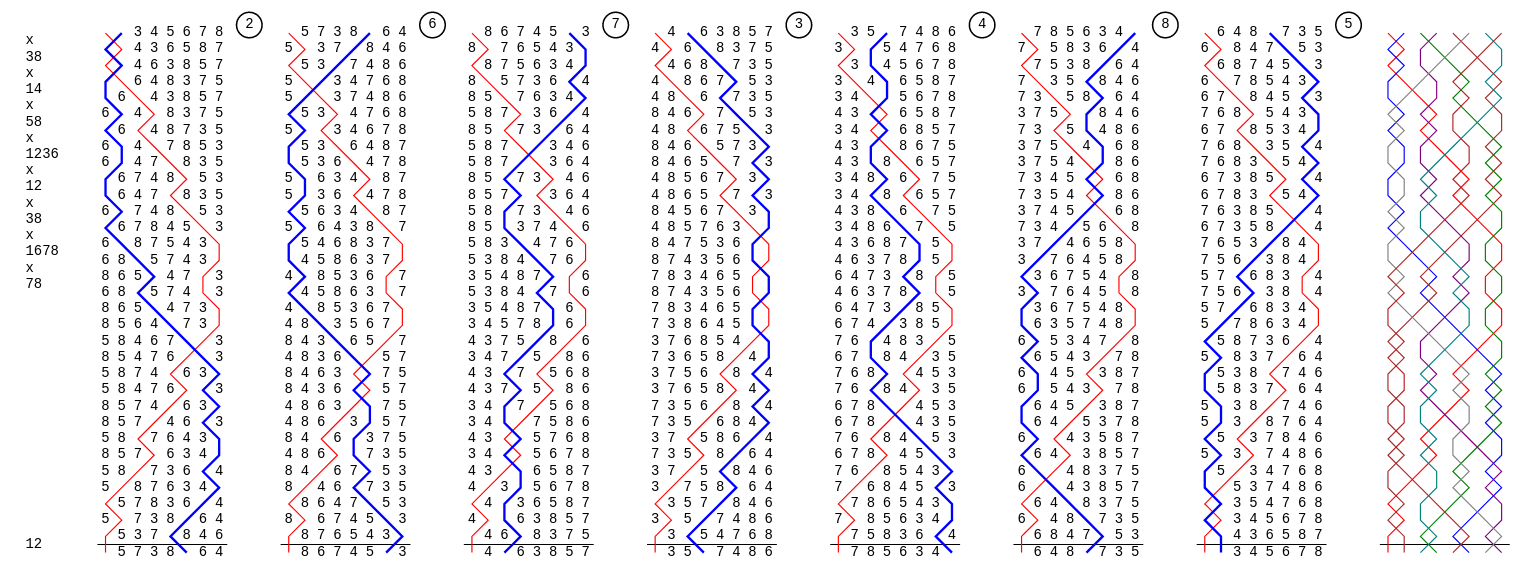
The way in which the pairs of bells are swapped is known as a method. There are thousands of already named methods and each ringing team only knows a relatively small number of them. If you put the changes in a method in a column you will see that each bell moves in a regular path, this is known as the “line” of the method and it is what the ringer has to learn in order to ring the method. In many methods the treble (lightest) bell follows a simple regular path which repeats frequently and the other bells follow a more complex path. This more complex path is usually shown in blue so we call it the “blue line”.
Creating the New Method
There are millions of possible methods but many of them would be far too complex for most ringers to learn. The simplest way to make a method easy to learn is to base it on something which is already familiar. In this case I based the method on Yorkshire Surprise Major which is one of the most popular eight bell methods. I have written some computer software which will take an existing method and “tweak” it to create a new method. My software checks that the tweaked method is valid (it doesn’t repeat any changes) and also checks that it is not an already named method. It also does some analysis of the musicality of the method. Whether a method is musical or not is probably a matter of taste but most people consider that methods which produce runs of bells in ascending or descending order to be more musical so the software counts the number of these runs. Finally I look at the blue line of the generated method to decide if it looks fairly straightforward to ring.
The method itself is 224 changes in length (this means the 224th change has come back to rounds). In order to name a new method you must ring at least a quarter peal in length. A peal is 5000 or more changes so a quarter peal is at least 1250 changes. To extend the 224 changes to 1250 or more we make variations in the sequence. These are usually when the treble is at the start of the change (we call this “leading”). These variations are known as “calls” and usually come in two varieties, “bobs” which affect 3 bells and “singles” which affect 2 bells. The “conductor” shouts “bob” or “single” at the appropriate time when ringing in order to extend the sequence to the desired number of changes. The sequence of calls is known as a “composition”. For the new method as it is fairly close to Yorkshire Surprise Major some of the compositions for Yorkshire will work so I am planning to use an existing 1250 change composition of Yorkshire.
Footnotes
-
Frome Festival is the actual name, Treble Place is the method type and Major indicates it is for 8 bells ↩